

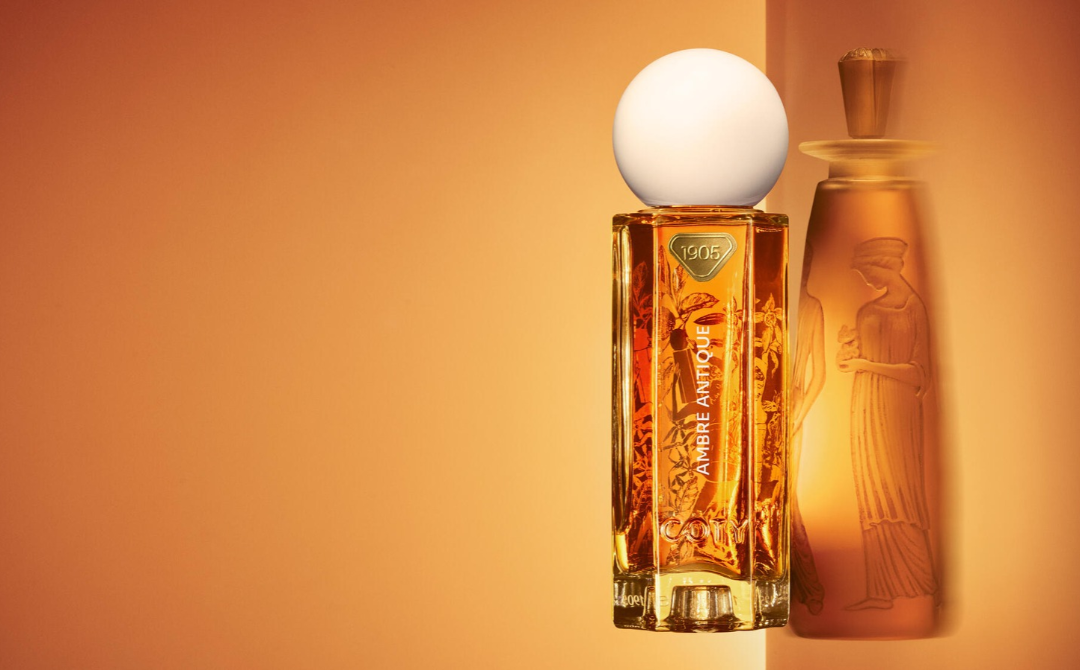
Last October, one of the world’s oldest fragrance houses introduced a perfume for the modern market by going back 120 years.
Coty’s Ambre Antique first appeared in 1905, created during the period when François Coty was helping to shape modern perfumery. For its 2025 return, Coty went back to its archives and reconstructed the historic fragrance, changing only what modern regulations and sourcing standards required and keeping its original structure largely intact. Even Ambréine S, a proprietary Coty accord first used in 1905, was reconstructed for the new edition. The timing was telling.
Fragrance has become a fast-moving business, shaped by social media trends, accelerated product cycles, and an enormous market for dupes. A successful scent can quickly be followed by products promising a similar experience for a fraction of the price. Coty’s response was to reach for something far harder to replicate: its own history.
“We were not interested in modernising the fragrance,” Coty CEO Sue Nabi told Vogue Business of Ambre Antique. The goal was to preserve the olfactory experience of the 1905 original.
A year on, that decision looks like part of something larger.
This September, Dior announced Dioriginals, a collection of 13 fragrances restored from the house archive by Francis Kurkdjian, spanning more than half a century from Diorama (1949) to Forever and Ever (2002). Kurkdjian spent four years bringing them as close as possible to their original formulations. Dolce & Gabbana’s 2025 Re-Edition fragrance collection, brought back Sicily and Masculine from its earlier catalog, while Balenciaga reimagined Le Dix, its first fragrance from 1947, as the center of its new high-perfumery collection.
Different houses are approaching their archives differently. Some are reconstructing, some reissuing, others reinterpreting, but the instinct is strikingly similar. When resemblance is abundant, the original becomes more interesting.
For anyone who works with antiques, this logic sounds familiar.
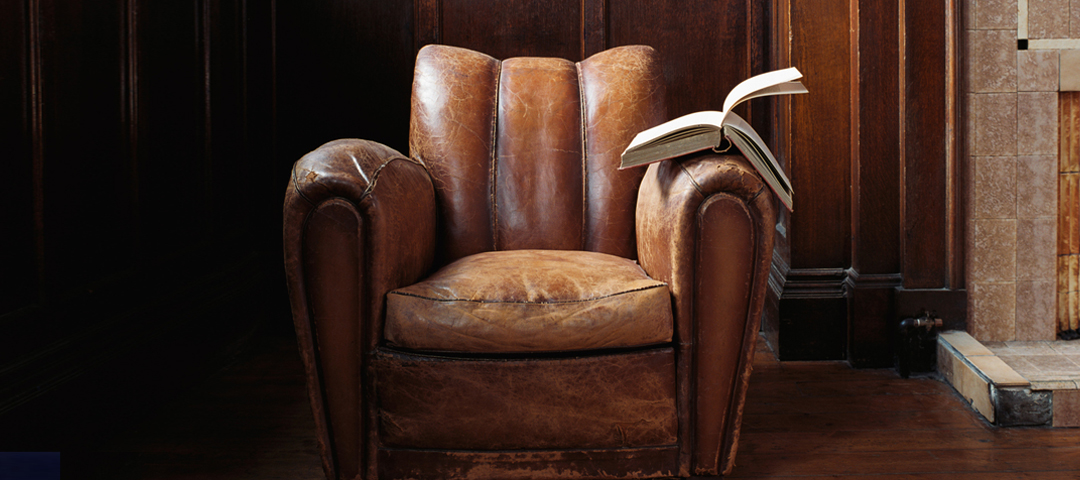
Interior design by David Scott Interiors
When Appearance Is No Longer Enough
We have become extremely adept at recreating an aesthetic. A newly made chair can reproduce the proportions of an 18th-century form. A contemporary light can closely echo a celebrated 20th-century design. New finishes can suggest decades of wear. Search engines can identify an object in seconds, and generative tools can produce an entire room around almost any historic reference.
None of that diminishes contemporary design. A beautifully conceived object made today has authorship, craftsmanship, and a history that is just beginning. But resemblance and provenance are not the same thing.
In 2026, Architectural Digest devoted an entire guide to identifying vintage furniture dupes, noting that authenticity lives in the details imitation struggles to reproduce convincingly. Provenance and seller transparency, the article argues, have become particularly important as copies grow more sophisticated.
What gives a 19th-century table its value belongs to the object itself: its construction, timber, joinery, alterations, makers’ marks, surface, and evidence of use. Each records decisions made by craftspeople and owners long before the table entered its present room. That distinction is more evident now that appearances have become so easy to reproduce.
Recent sourcing data suggests designers are already moving in that direction. In the 1stDibs 2026 Interior Designer Trends Survey, based on responses from 468 design professionals worldwide, vintage and antique pieces accounted for an average of 36 percent of everything designers sourced for projects in 2025, the highest proportion recorded since 2021. Eighty-five percent sourced vintage pieces, while the use of pre-1920 antiques also rose.
The same survey found maximalism and eclecticism among the most requested aesthetics for 2026. Interiors assembled from objects of different periods, origins, and histories, create an aesthetic that resists being reduced to a single identifiable look. House & Garden reached a similar conclusion in its 2026 survey of leading British designers, describing memorable interiors as considered mixtures of heirlooms, new discoveries, bespoke pieces, and antiques spanning different eras.
In other words, what distinguishes a room is how difficult it would be to reproduce.
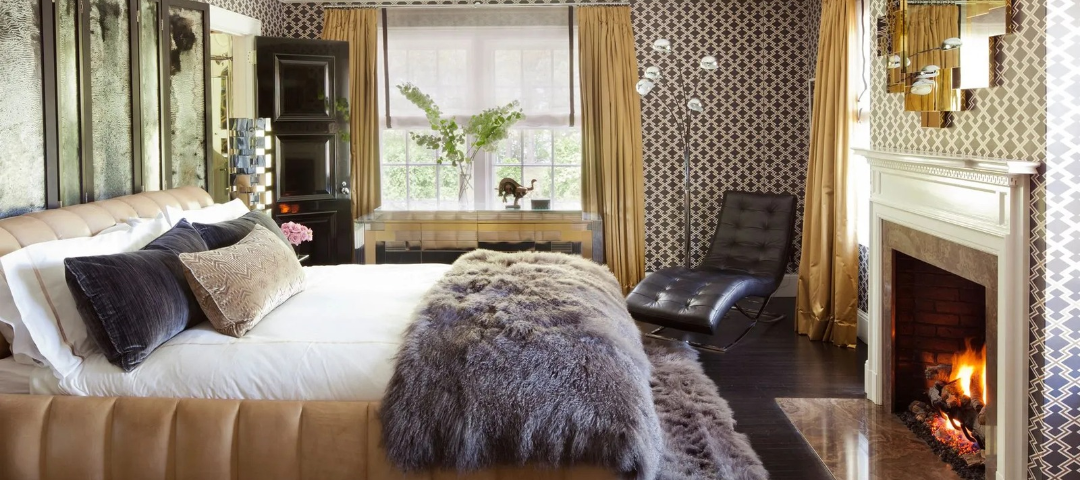
Interior design by Martyn Lawrence Bullard
The Value of Something That Has Already Lived
For interior designer Martyn Lawrence Bullard, antiques have been part of the story from the beginning. In a 2026 Homes & Gardens interview, Bullard recalled convincing his father to rent him a stall at Greenwich Market when he was still a child. He would search junk shops for silver, ceramics, and other finds, eventually moving into antique jewelry before his career took him from London to Hollywood. Decades later, that instinct to collect remains embedded in his interiors. His own homes have included Italian antique furniture, midcentury pieces, and objects gathered across periods and places. As he puts it simply, “I love eclectic.”
That eclecticism feels especially relevant today. In Veranda’s 2026 survey of antiques worth collecting, Bullard pointed to Georgian and Regency furniture as an area of renewed opportunity, singling out chests, dining chairs, secretaries, and side tables. These pieces, he noted, still offer remarkable value and “have such beauty.” He also sees growing interest among younger buyers who are using antiques alongside contemporary pieces rather than recreating historically uniform rooms.
An antique keeps its identity outside a period room, and its history can become even more visible when it is placed in conversation with something entirely different. Bullard’s own interiors have long operated this way, letting objects from different eras and cultures coexist. The result feels collected over time.
That kind of room cannot easily be bought all at once. Its character comes from specificity: pieces with different origins, makers, histories, and periods brought together because they hold their own. The value lies in what the objects bring with them: histories that began long before the room was ever conceived.
Perhaps this is one reason antiques feel so relevant in interiors now. After years of images circulating at extraordinary speed, with rooms saved, copied, shopped, and recreated through ever more efficient digital channels, there is a growing appetite for interiors that feel more personal and less easily reproduced.
The numbers support that shift. Last year, 1stDibs found that designers were moving decisively toward eclecticism and more individual rooms, with 62 percent expecting to source antiques for their clients and the same percentage favoring artisanal production over mass manufacture. In 2026, the share of project sourcing devoted to vintage and antiques had climbed further.
What looks like nostalgia may actually be a search for originality.
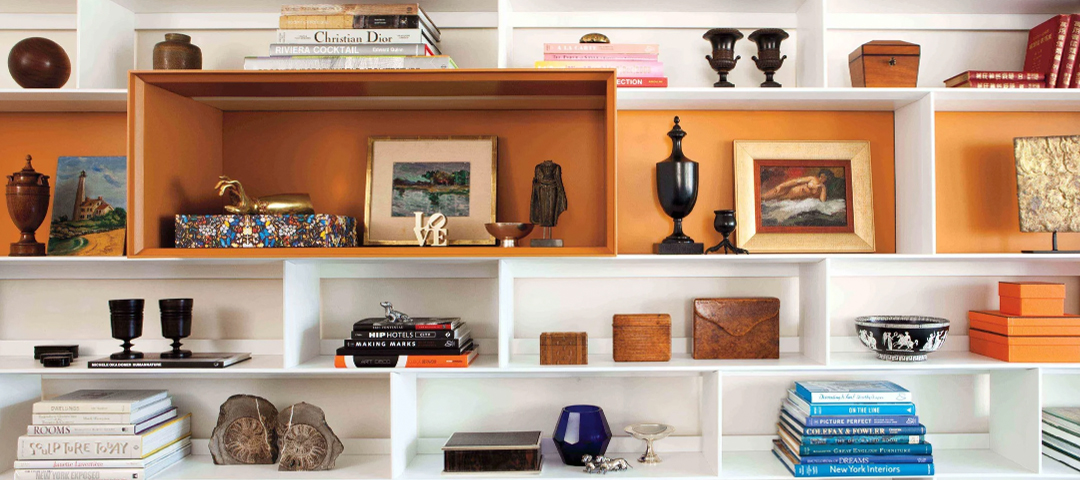
Interior design by David Scott Interiors
The Part That Cannot Be Copied
A convincing reproduction can recreate a silhouette. It can recreate dimensions, ornament, color, and finish. With sufficient craftsmanship, it may be an exceptional object in its own right. What it cannot reproduce is the unique sequence of events that shaped the original.
That is where provenance enters the conversation.
Veranda made a similar distinction in June 2026, examining the antique categories most vulnerable to counterfeiting and the clues that separate copies from originals. Its premise: authenticity is what distinguishes a room genuinely furnished with historic objects from one that only recreates the look of the past.
Provenance is often associated with the grander side of antiques scholarship: illustrious collections, historic houses, famous owners. But in practice, an object’s history is often more subtle. It might be a maker’s stamp or a regional construction method, a repair completed generations ago, a label underneath a drawer, an old photograph showing the piece in a previous interior, or a dealer’s knowledge of where it was acquired.
These details do more than authenticate. Together, they make one object distinct from every object it merely resembles.
Interior designer David Scott has described his own approach to interiors in terms that feel pertinent: “Design, for me, is more curation than decoration.” For his Kips Bay Show House room, Scott told the New York School of Interior Design he wanted visitors to understand who stood behind each object, how it was made, and the craftsmanship involved.
That emphasis on the maker’s hand comes at a moment when digital culture has given us nearly unlimited access to images. AI has accelerated that still further. The 1stDibs 2025 survey that recorded designers’ growing interest in antiques also found that the proportion of designers using AI tools had tripled, from 9 percent in 2023 to 29 percent in 2025.
The more efficient technology becomes at creating possibilities, references, and representations, the more meaningful the physical characteristics of a real object can become. The mark left by a tool, the variation produced by hand, the surface changed by a century of contact: these are evidence.
An image can imitate them. An object has experienced them.
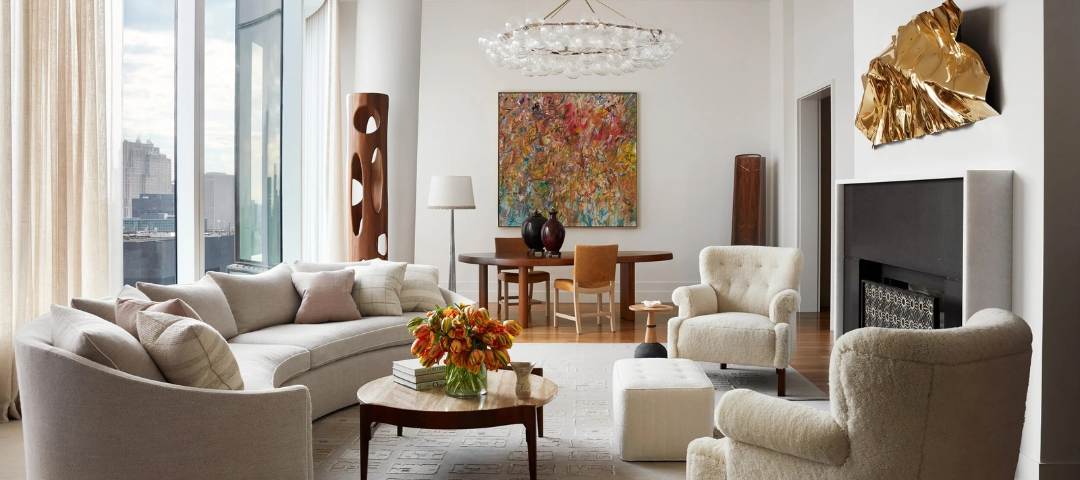
Interior design by David Scott Interiors
A Different Kind of Luxury
This brings us back to a bottle of perfume. Coty could have created another amber fragrance in 2025. Instead, it chose the one it had made in 1905. That’s a different kind of luxury: something a competitor cannot buy its way into.
Choosing the original turned the archive into something more than a marketing reference. Coty had access to formulas, proprietary knowledge, and institutional history that another fragrance company could not simply acquire by studying the finished scent. As Nabi told Vogue Business, the company could revisit the formula with a level of access and understanding that would be difficult to reproduce externally.
An established dealer operates on a different scale, but there is a useful parallel. Almost every historic style can be referenced, reproduced, photographed, or searched online. The great advantage of the antiques trade is access to the things themselves, and the knowledge required to understand them.
As copies become easier to make and visual inspiration easier to obtain, expertise becomes invaluable. That means knowing whether something is period or later and which alterations matter, recognizing construction techniques, understanding restoration, establishing attribution responsibly, and recording what is known while being equally clear about what is not. That information allows an object to move through the market with its identity intact.
For dealers, there is a practical implication here. An object’s history belongs at the front of the sale, as part of what distinguishes the piece in the first place: a good photograph can show us form, a thoughtful description can explain construction, age, origin, condition, and craftsmanship, documentation can preserve the information that might otherwise disappear as the piece changes hands, and provenance can turn an attractive object into a specific one.
The fragrance world has discovered that an archive can offer something novelty cannot. Interior designers appear to be making a related discovery as they source more antiques and build more layered, individual rooms.
Perhaps that is the real return to the original: a renewed appreciation for things that arrive in the present carrying something with them. In a world that can reproduce how almost anything looks, history remains remarkably difficult to copy.
Lead image courtesy of Coty.