


Each year, we find ourselves returning to a familiar question: Where should I list online to increase sales?
It sounds simple. In practice, it rarely is.
In Ronati Founder & CEO Stacey Tiveron’s words:
“The pieces you source are real. The buyers seeking them are real … Marketplaces help them find one another.”
That idea holds. But the way those connections happen — and where they begin — continues to shift.
Over the past five years, we’ve worked closely with dealers across the US and UK documenting inventory, refining workflows, and helping bring one-of-a-kind pieces into view. Through that work, one truth has remained consistent: success in online marketplaces isn’t just about presence. It’s about placement, context, and timing.
Knowing not just where something lives, but where it’s most likely to be understood.
That perspective is what continues to shape Ronati’s Guide to Online Marketplaces for Sellers of Art, Vintage, and Antiques, developed in partnership with LAPADA and refreshed each year to reflect how the market is actually moving.
A Market in Motion
The art and antiques market enters 2026 with a sense of cautious optimism. There are still pressures — rising costs, global uncertainty — but there is also a steady sense of momentum. What’s changing is not just the market itself, but the mindset around it.
A new generation of collectors is coming into view: one that values individuality, material history, and sustainability over convention. At the same time, established buyers continue to seek expertise, provenance, and trust.
It’s within that overlap that marketplaces begin to influence how pieces are found.
Quietly, but meaningfully.
They’re not simply transactional platforms. They’re places of discovery. Where a piece is encountered unexpectedly. Where a designer pauses. Where a collector begins to see something new. They exist alongside everything else — fairs, relationships, social platforms — as part of a broader rhythm of how unique items move through the world.
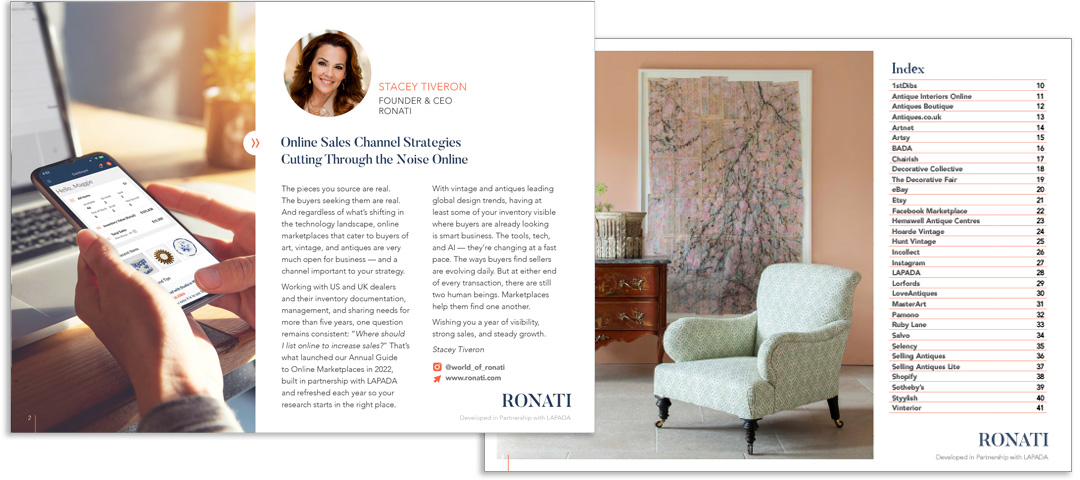
Ronati’s Guide to Online Marketplaces for Sellers of Art, Vintage, + Antiques
Not all Visibility is the Same
It’s easy to assume that being visible online is enough. That once a piece is listed, it’s effectively “out there.” But visibility, in practice, is far more nuanced.
Some platforms are highly curated, shaped by a particular aesthetic or echelon of inventory. Others are expansive, offering reach and flexibility. Some are deeply embedded in the design trade. Others attract a wider audience, moving across categories and price points with ease.
And within each of them, there’s another layer — how a piece is photographed, how it’s described, how it’s positioned in relation to everything around it.
The difference between being seen and being understood often lives there.
The 2026 Guide brings together more than 30 online marketplaces serving the US, UK, EU, and global markets, offering a clearer way to navigate what can otherwise feel fragmented.
Not as a checklist, but as a lens.
Because the goal isn’t simply to place inventory. It’s to place it well.
Hidden in Plain Sight
For many dealers, the challenge isn’t sourcing, it’s visibility.
Pieces live in showrooms layered with history. In storage, waiting for the right moment. At fairs, where they’re seen briefly and remembered selectively. Within networks where access is shaped by proximity and familiarity.
They exist — often beautifully — but not always where buyers are looking.
Marketplaces offer a way to extend that reach. To bring pieces into new contexts and allow them to be discovered by someone who may not have encountered them otherwise.
But visibility isn’t just about listing. It’s about how a piece is documented, how it’s described, where it’s placed, and whether it remains present long enough to be found.
When those elements align, inventory begins to move differently. Not faster, but more intentionally.
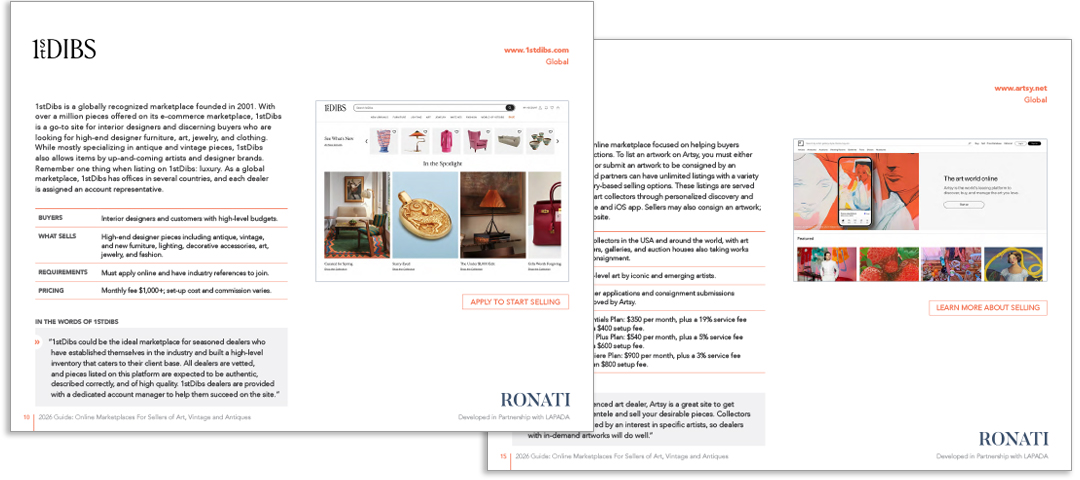
Ronati’s Guide to Online Marketplaces for Sellers of Art, Vintage, + Antiques
Bringing Clarity to a Complex Landscape
If marketplaces can feel difficult to navigate, it’s because they are.
And part of our role is to bring a sense of structure to that complexity — not by reducing it, but by making it more legible.
This Guide is one way of doing that. A way to gather what’s often scattered, to offer a clearer view of the platforms available, and how they function in practice, so that decisions feel less reactive and more intentional. Because participating in marketplaces isn’t just about access. It’s about alignment between your inventory, your audience, and the environments where those two meet.
A Guide, and Something More
The 2026 Guide to Online Marketplaces is designed to be something you return to. Not just as a reference, but as a way of thinking through where your inventory lives — and where it might live next, at any point you find yourself reassessing what’s working and what isn’t.
Because even as tools change, and the ways we sell continue to expand, something more fundamental remains: every sale begins with recognition.
Marketplaces simply create more opportunities for that moment to happen.
Explore the 2026 Guide to Online Marketplaces
Developed in partnership with LAPADA, this year’s edition brings together the platforms, structures, and insights shaping how art, vintage, and antiques are sold online today
Header image courtesy of Lorford’s