


There is a kind of beauty that only time can make: silver softens, bronze darkens, copper blooms into verdigris. Gilding wears at the edges, revealing traces of the hand beneath it. Even the most polished metal carries the possibility of transformation.
This October, that idea takes center stage at the 44th edition of the San Francisco Fall Show, returning to Fort Mason Center for Arts & Culture from October 15 through 18, with its celebrated Opening Night Gala on October 14.
The theme for 2026 is Métallique Chic, a celebration of metal in its many expressions: gold leaf and silver filigree, copper patina and pearlescent pewter, Georgian silver, Rococo gilding, Brutalist metalwork, and the burnished surfaces that reveal what decades, or centuries, of use can leave behind.
It is a theme made for an antiques fair. Few materials record their histories quite so visibly.
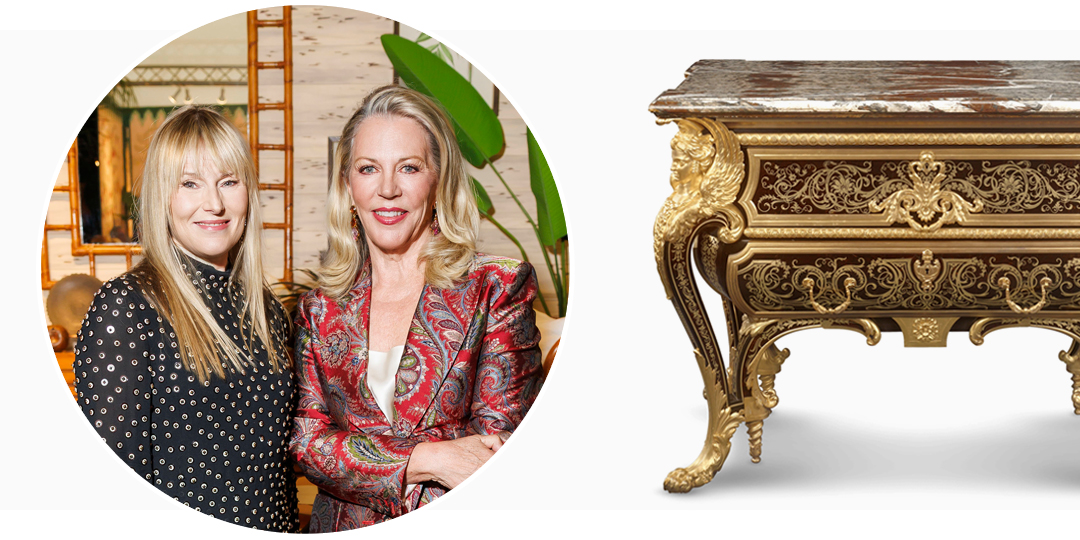
Amy Astley and Suzanne Tucker at the San Francisco Fall Show. Photo by Drew Altizer | The Royal Boulle Marquetry Commode by Robert Blake (circa 1850), modeled after the legendary pair of commodes made for France’s King Louis XIV by master ébéniste André-Charles Boulle. Courtesy of M.S. Rau.
The Beauty of Transformation
Show Chair Suzanne Tucker describes Métallique Chic as a celebration of the “enduring allure of metal in all its forms,” from the polished and gilded to surfaces “patinated by time.”
That final phrase may be the most telling. Within the world of antiques and decorative arts, patina can be evidence of age, craftsmanship, handling, exposure, and use. A bronze that has deepened over generations or a piece of silver bearing the subtle traces of countless tables carries something that a newly finished object cannot reproduce: a visible relationship with time.
The Show’s theme gathers objects whose histories span periods and disciplines. Among the objects highlighted in this year’s materials are a Russian Imperial silver punch set hallmarked during the reign of Alexander III and a circa-1850 marquetry commode by Robert Blake, modeled after André-Charles Boulle’s celebrated commodes for Louis XIV.
Elsewhere, metal becomes intimate and wearable. Midcentury textured gold earrings take the form of angel wings, while a French Retro rose-gold bracelet turns something as utilitarian as a link into ornament.
What unites them is material shaped by imagination, skill, and time.

Honorary Co-Chairs Zac Posen and Stellene Volandes | Yellow gold bangle bracelet. Courtesy of Rosior.
Zac Posen and the Hand Behind the Object
The meeting point between construction and artistry also makes Zac Posen a fitting Honorary Co-Chair for this year’s Show. He shares the role with Stellene Volandes, Editor-in-Chief of Town & Country and Editorial and Brand Director of ELLE Decor.
Posen’s work has long been associated with sculptural form and highly considered construction, and his current role as Executive Vice President and Creative Director of Gap Inc. has brought those instincts into a different design vocabulary.
Speaking recently about his Fall 2026 GapStudio collection, Posen described his interest in the point where “industrialism met craft.”
Much of what draws us to historic furniture, jewelry, silver, and decorative objects lies in precisely that tension: technique and artistry, function and ornament, repetition and the individual hand. A metalworker may begin with a material capable of industrial strength and end with something extraordinarily delicate. A cabinetmaker can use brass or gilt bronze to articulate form. A jeweler can turn gold into something that appears almost weightless.
Posen will explore those broader connections on the Show’s opening day in Fashioning a Life in Style — Grand Gestures in Design, from Town to Country, joining designer Ken Fulk in conversation with Volandes. The discussion will move between fashion, interiors, art, antiques, collecting, and the cultivation of personal style. These disciplines may appear distinct until one considers how often they begin with the same things: proportion, craftsmanship, curiosity, and a trained eye.
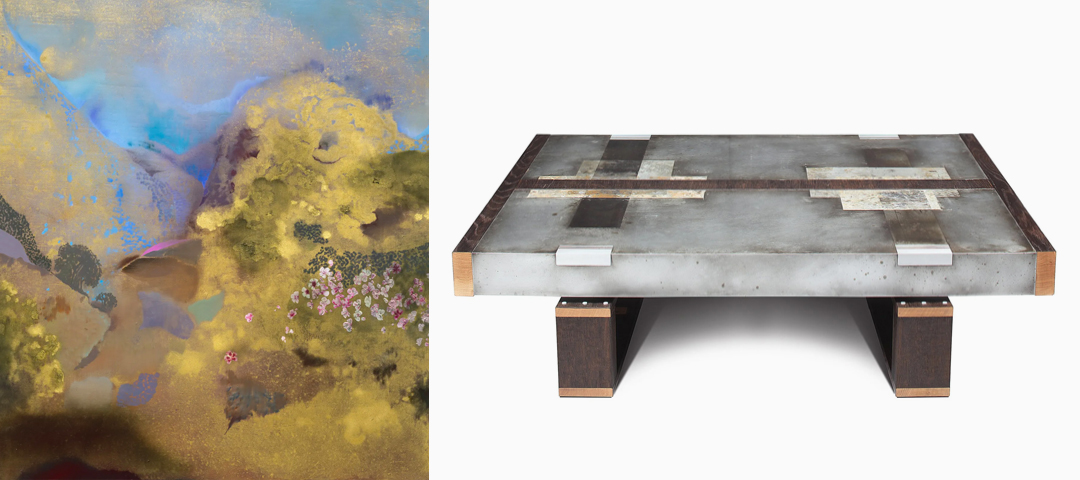
After Joy, 2026, by Darren Waterston, oil on wood panel. Courtesy of Berggruen Gallery | Divided Lands zinc acid-etched coffee table, designed by Florian Roeper in 2004. Courtesy of Studio Roeper.
A Show Built Around the Art of Observation
That eye is what the San Francisco Fall Show has cultivated for more than four decades. This year, more than 40 exhibitors will bring fine and decorative arts spanning antiquity through the present, including European and American furniture, contemporary art, estate jewelry, textiles, ceramics, silver, works on paper, watches, sculpture, and design.
This breadth reflects how far the Fall Show has moved beyond the expectation that historical objects should remain within neatly defined stylistic categories. An 18th-century commode can sit in conversation with contemporary sculpture. Midcentury furniture can live beside old masterworks on paper. Estate jewelry, modern art, ancient objects, and newly made pieces share the same visual field.
For dealers, designers, and collectors, this is where the pleasure begins. The Show creates an opportunity to look across periods rather than within them, to notice relationships that might otherwise be missed: the echo of a Rococo curve in a contemporary form, the shared geometry of Art Deco metalwork and modern sculpture, or the way a centuries-old silver object can feel strikingly current when removed from the context of a period room.
Tucker herself remains, by her own account, “always on the hunt,” particularly for objects with soul, story, and permanence. Those qualities have little to do with chronology. They are what allow an object to move from one setting, one generation, and one owner to another.
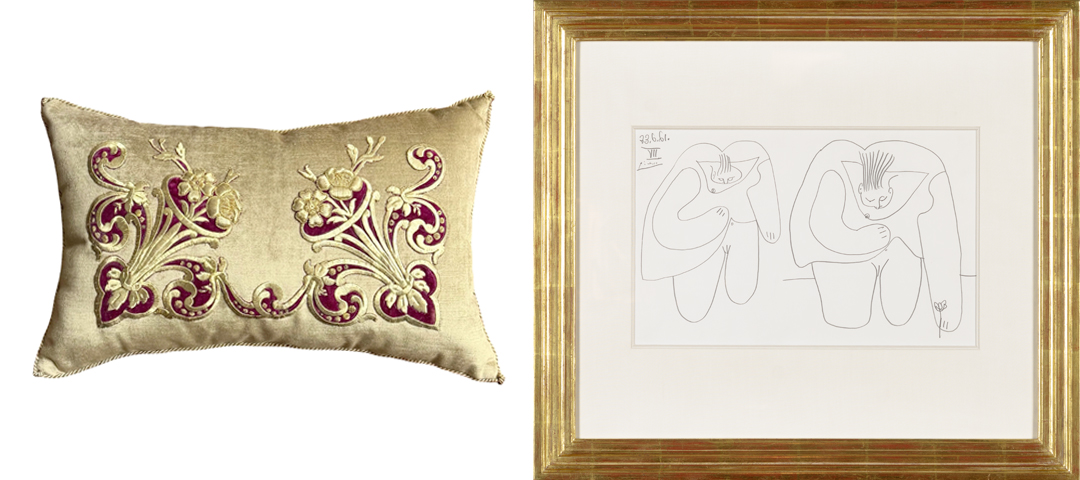
Antique Ottoman Empire raised gold metallic embroidery with some original burgundy velvet, removed from a Turkish bohça and restitched by hand to antique brass velvet, hand-trimmed with vintage gold metallic cording knotted at the corners. Courtesy of B. Viz Design. | Les Déjeuners, Études VII (d’après Manet), 1961, by Pablo Picasso, pencil drawing on wove paper bearing the “les Annonay” watermark. Courtesy of Christopher-Clark Fine Art.
Four Rooms, Four Interpretations
The interplay between old and new will be especially visible in the Show’s Grand Entry Hall Vignettes, one of its most anticipated traditions.
For 2026, six members of the Design Council will create four rooms using works sourced from Show exhibitors alongside wallpapers by Schumacher. The designers are Meg Braff; Christine and John Gachot of GACHOT; Elizabeth Lawrence of Williams Lawrence with architect Scott J. Sottile of Ferguson & Shamamian; and Christopher Roy of Christopher Roy & Co.
The installations give the objects something a fair booth cannot always provide: context. Furniture becomes part of a room. Art takes its cues from the architecture around it. A piece of silver or bronze that might be admired independently acquires a new role when placed beside textiles, lighting, color, and other collected objects.
Released from stylistic amber, antiques often show their relevance most clearly when they are allowed to participate in the present.
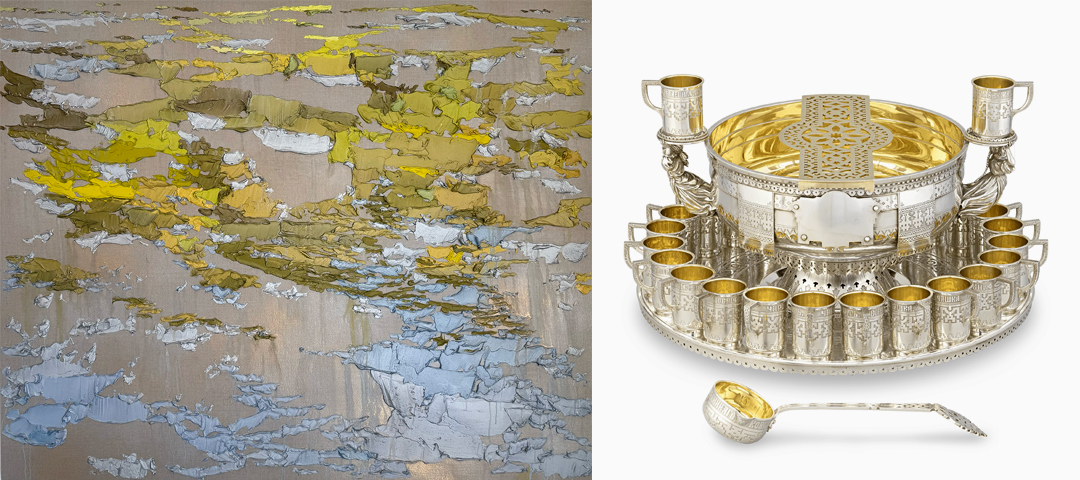
Take Me Back by Brendan Stuart Burns, oil on linen. Courtesy of Caldwell Snyder | Russian Imperial Silver Punch Set from Czar Alexander III, hallmarked 1874–75. Courtesy of M.S. Rau.
Collecting, Entertaining, and the City
The lecture series that spirit of participation through all four days.
Charlotte Moss will join Suzanne Tucker to talk about travel, collecting, houses, gardens, and the way a lifetime of looking informs the spaces we create. Meg Braff, Christine Gachot, Mish Tworkowski, and Flower Magazine founder Margot Shaw will consider thoughtful entertaining and the collected table. Jay Jeffers and architect Richard Beard will discuss collaboration and the continued influence of design traditions on contemporary homes.
On Sunday, the focus turns directly to San Francisco, with Anu Jain, Chloe Redmond Warner, and Christopher Roy considering how a new generation of designers is working within a city already rich in architectural and collecting traditions.
Together, the program makes the Show a place to understand beautiful things as well as acquire them.
That purpose carries added weight this year, as the San Francisco Fall Show has returned to nonprofit status with a stated mission to preserve and advance the decorative arts through education and a deeper appreciation of craftsmanship, design, and cultural heritage.
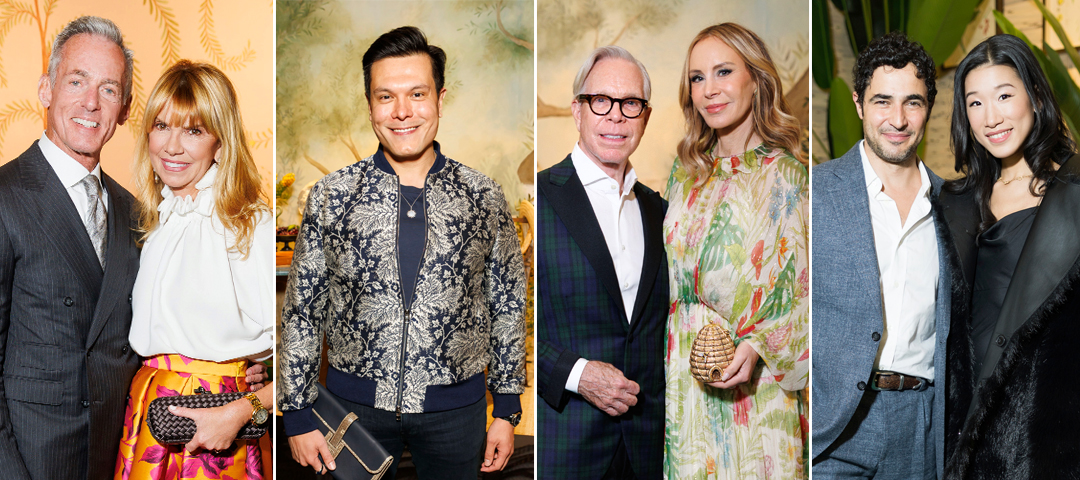
From left: David Kleinberg and Chesie Breen; Michael P.N.A. Hormel; Tommy and Dee Hilfiger; Zac Posen and Becca Bloom at the 2025 San Francisco Fall Show Opening Night Gala. Photo by Drew Altizer.
What Endures
Métallique Chic may sparkle, but its most interesting idea lies beneath the shine. Metal can be glamorous. It can also be practical, architectural, ceremonial, industrial, domestic, or deeply personal. It can arrive at a fair gleaming as though untouched, or carrying hundreds of years on its surface.
Both have a place here.
And perhaps that is what makes this year’s theme particularly resonant for the antiques world. The finest objects rarely remain static. They age. They move between collections. They acquire marks, histories, associations, and new contexts. Their surfaces change while something essential endures.
Tucker describes the Fall Show as four days of dealers, lectures, and what she cheerfully calls ‘gobs of eye candy,’ an event for anyone who wants to buy, collect, learn, or simply immerse themselves in exceptional objects.
This October, there should be plenty to catch the eye. But at Métallique Chic, the richest stories may belong to the objects whose shine has softened: the silver worn warm, the bronze darkened, the gilt rubbed gently away.
The San Francisco Fall Show takes place October 15–18, 2026, at the Festival Pavilion at Fort Mason Center for Arts & Culture. The Opening Night Gala will be held October 14. Ronati is pleased to partner with the 2026 San Francisco Fall Show.
For tickets and full details, visit sffallshow.org.
Lead image: Flooded River with Tilted Tree, 2000, by Stephen Hannock, oil on board. Courtesy of Berggruen Gallery.