


There are few industries where the question Who do you know? carries quite the same meaning as it does in the world of vintage and antiques.
It can mean: Who taught you? Who have you worked with? Who would recommend you? Who can confirm what you believe about an object? Who do you call when something falls outside your own expertise? And, increasingly, it can mean something else.
Who can I trust?
For generations, the art, vintage, and antiques trade has answered that question through people. Reputation travels. Expertise is earned. Relationships develop across fairs, galleries, auction rooms, associations, and years of doing business together. Those structures have always been important. Today, they’re taking on renewed significance.
Trust in a Changing Marketplace
Today, the question itself hasn’t changed. What’s changed is how hard it’s gotten to answer.
Technology has dramatically expanded what is possible for an independent dealer. A business can reach buyers around the world. Inventory can move from a storeroom to a screen almost instantly. A dealer working from a small gallery can have an international presence that once would have required considerably more infrastructure.
AI is accelerating that shift further. And while there is enormous promise in the emerging technology of this moment, there is also a new difficulty: appearances have become easier to create. A polished website can be built quickly. Content can be produced at tremendous scale. Reviews, engagement, and even the appearance of expertise can be increasingly difficult to assess from a screen alone.
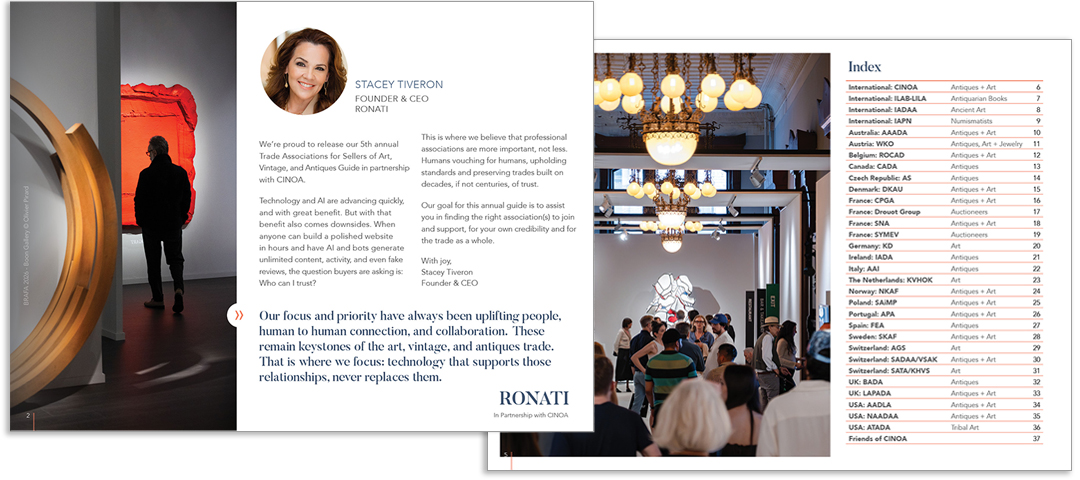
As Ronati Founder & CEO Stacey Tiveron writes in the introduction to our fifth annual Guide to Trade Associations for Sellers of Art, Vintage, and Antiques, created in partnership with CINOA:
“When anyone can build a polished website in hours and have AI and bots generate unlimited content, activity, and even fake reviews, the question buyers are asking is: Who can I trust?”
Her answer points back to something very old: “humans vouching for humans.”
Professional associations have been doing exactly that for generations.
The Meaning Behind the Name
For a dealer, that work of vouching rarely shows up as anything dramatic. It looks like a name on a website, a logo on a fair stand, or a listing in a directory.
Behind it sits something more substantial. Depending on the organization, membership may involve professional standards, codes of conduct, vetting, references, specialist knowledge, or expectations around ethical practice. It places an individual business within a wider professional community. In a field where so much rests on knowledge and judgment, that connection speaks for itself.
A collector considering an unfamiliar dealer may notice it. So may a designer sourcing an important piece for a client. For colleagues within the trade, membership can provide recognition before a conversation has even begun. Credibility, after all, is rarely established in a single moment. It accumulates. Some of that accumulation happens in the open … a membership badge, a name recognized at a fair. Some of it happens somewhere a badge can’t show you.
The People Behind the Objects
Associations bring dealers together. This may be one of their most enduring functions in a profession made up of highly independent businesses and deep individual specialties. One dealer may know French furniture. Another may have spent a career studying ceramics, silver, textiles, modern design, or Old Master paintings. The strength of the trade has always come partly from that distributed knowledge, and from knowing where to turn when your own knowledge reaches its edge.
Associations create the conditions for those relationships to grow.
Sometimes that happens formally, through events, educational programs, fairs, committees, or professional resources. Often it happens more subtly: a referral made, an introduction offered, an opinion sought, a piece of information exchanged between colleagues. Over time, those connections become part of the infrastructure of the trade itself.
A Voice Larger Than One Business
There are moments, however, when connection needs to extend beyond individual relationships. The regulatory environment surrounding art and antiques has become increasingly complex. Cultural property rules, anti-money-laundering requirements, cross-border trade, taxation, and changing legislation all impact businesses that are often small in size, but international in reach.
One dealer can understand those changes. A collective can help shape the conversation.
For CINOA President Patrick Mestdagh, this is central to the role associations play today:
“We are all adapting to new regulations, changing markets and increasing expectations. In times like these, it is more important than ever that we work together and make sure the voice of the trade is heard.”
Founded in 1935, CINOA now represents 30 member associations in 22 countries and more than 5,000 art and antique dealers. That scale offers a useful illustration of what associations can make possible. Individual dealers belong to communities; those communities connect across borders. Together, they can advocate for legislation that reflects how the market actually functions and for the people whose livelihoods depend upon it.
Preserving More Than Objects
Livelihoods aren’t the only thing at stake.
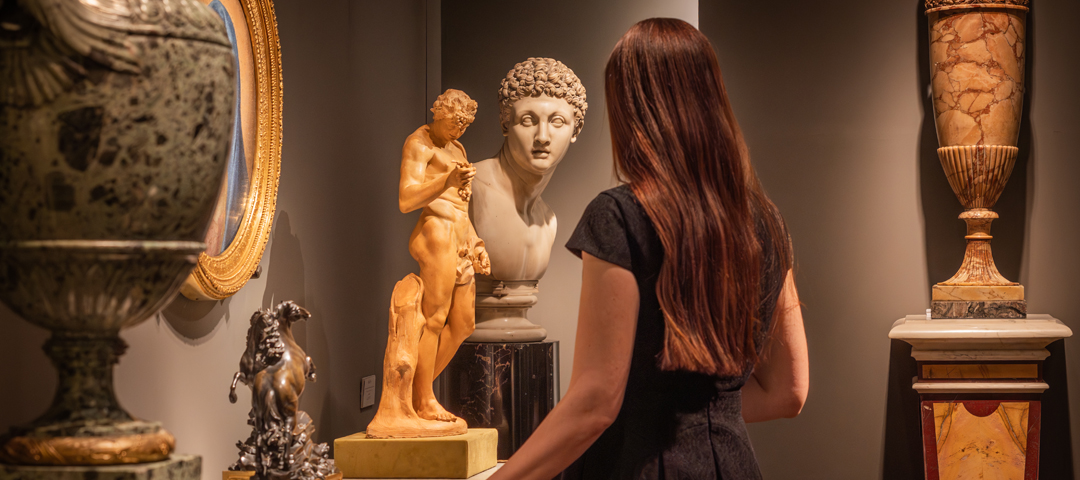
Dealers do far more than facilitate transactions. They research histories, identify makers, recognize alterations, trace provenance, understand techniques, preserve records, and carry specialist knowledge forward. A career spent handling objects develops a form of expertise that cannot always be reduced to a database entry or search result.
Mestdagh describes dealers as people who “research, authenticate, preserve and pass on works of art and cultural heritage.” That knowledge moves through the trade in much the same way objects do: from one person to another.
Associations help give it somewhere to live. They connect established expertise with emerging dealers. They preserve professional standards. They create forums where knowledge can be shared rather than held in isolation. And they remind us that the trade itself is part of the cultural ecosystem surrounding the objects it handles.
Finding Your Place in the Trade
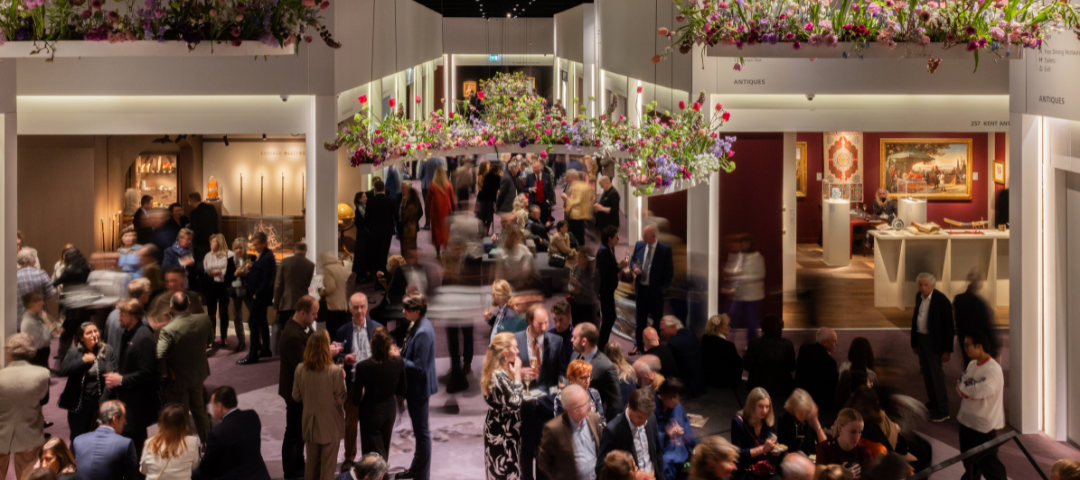
There is no universal association for every dealer. A specialist in English furniture may need something different from a contemporary design dealer. A business in Paris operates within a different professional landscape from one in New York or the English countryside. Some dealers may find their strongest community through a regional organization; others through one devoted to a particular discipline. The important thing is knowing what exists.
That is the idea behind Ronati’s fifth annual Guide to Trade Associations for Sellers of Art, Vintage, and Antiques, created in partnership with CINOA. The new edition brings together more than 30 associations across the United States, United Kingdom, and Europe, offering a clearer view of the organizations supporting dealers, setting standards, creating professional connections, and representing the trade.
Because even as the ways we buy, sell, communicate, and discover continue to evolve, this remains a business built largely on people. People sharing knowledge. People standing behind their reputations. People introducing one another, advocating for one another, and preserving expertise that took generations to build.
Or, as Stacey puts it, “human to human connection, and collaboration.”
Some forms of infrastructure are technological. Others are human.
The trade needs both.
Download the Ronati Guide to Trade Associations, created in partnership with CINOA, to explore more than 30 organizations serving the international art, vintage, and antiques community and discover how association membership can support your business and the wider trade.